Home » MCC (Merchant Category Code)

MCC (Merchant Category Code)

Content on MCC (merchant category code) and how it drives underwriting, pricing and approval rates in high-risk payments. We explain how MCCs classify merchant activity, affect acquirer risk appetite and scheme programs, and when regulators/schemes require specific MCCs (separate MIDs for sub-verticals, PayFac sub-merchant coding). Practical playbooks cover: correct coding and evidence (site/flows/ToS), approval-rate optimization by MCC, local vs cross-border acquiring, 3DS/SCA strategy by risk, descriptor clarity, and dispute exposure.
High-risk examples include 7995 (betting/gaming), 6211 (securities/CFD/FX) and 6051 (quasi-cash). We also discuss BIN/issuer-geo rules, MCC-based routing/filters, network monitoring thresholds, and audit-readiness for acquirer reviews.

Best-practice checklist related to MCC (merchant category code):

  • Confirm MCC during onboarding; avoid miscoding that triggers non-compliance/fines.

  • Use separate MIDs per MCC when models differ (e.g., gambling vs marketplace payouts).

  • Tune risk rules by MCC (velocity, prepaid rules, geofencing) and align 3DS exemptions carefully.

  • Track KPIs by MCC: auth rate, soft vs hard declines, dispute ratio, refund-before-dispute rate.

  • Keep processor documentation and screenshots to support assigned MCC during audits.

Authoritative outbound resources

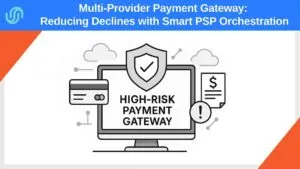
Multi-Provider Payment Gateway: Reducing Declines with Smart PSP Orchestration

Illustration of a high-risk payment gateway with smart PSP orchestration showing card, warning icon, and security shield on a monitor.

Declined payments are more than a technical glitch — they’re lost conversions, frustrated users, and lower LTV. In high-risk industries like iGaming, dating, crypto, and Forex, decline rates can easily exceed 30%, especially when relying on a single PSP. That’s why leading merchants are adopting multi-provider payment gateway architectures powered by smart PSP orchestration platforms. These systems intelligently route transactions, apply fallback logic, and monitor performance — all with one goal: decline rate optimization.

In this article, we show how to reduce failed payments using orchestration strategies and real-world routing logic, without rebuilding your stack.

Multi-Provider Payment Gateway: Reducing Declines with Smart PSP Orchestration Read More »

Crypto On-Ramps and Off-Ramps for High-Risk

Bridge connecting traditional finance to cryptocurrency with on-ramps and off-ramps for high-risk businesses

Crypto on-ramps and crypto off-ramps serve as critical infrastructure for businesses operating in high-risk sectors like iGaming, crypto businesses, forex trading platforms, and dating services. Understanding these gateway mechanisms is essential for seamless operation and regulatory compliance in industries that often face heightened scrutiny from traditional financial institutions.

Crypto On-Ramps and Off-Ramps for High-Risk Read More »