
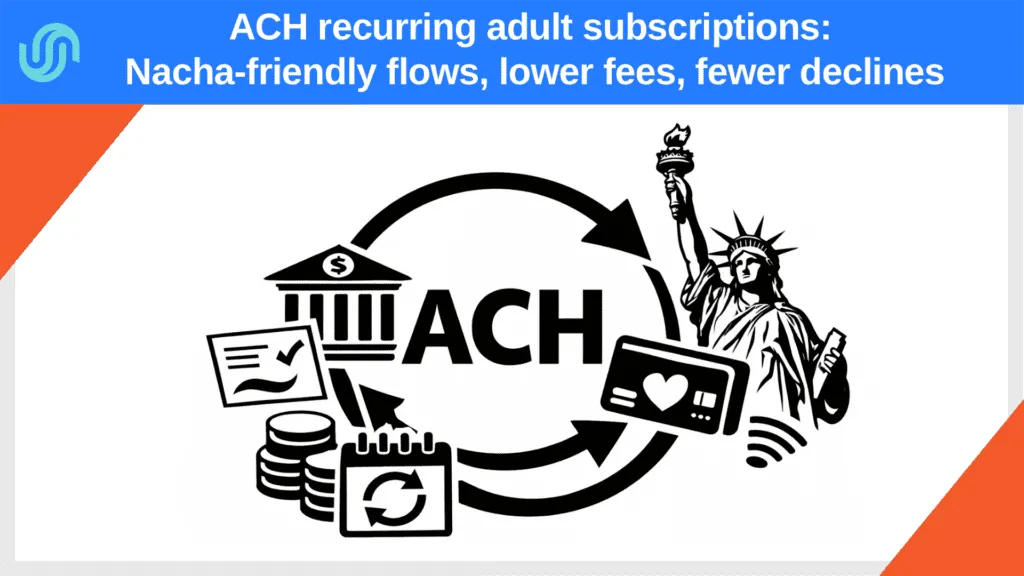
For adult and dating merchants in the U.S., card acquiring is usually the primary rail—but ACH recurring adult subscriptions can be a smart secondary rail for certain segments: lower fees, fewer “card expired” failures, and sometimes better long-term retention.
The key is doing it in a Nacha-friendly way, with clear authorization language, mandate storage, and returns management. ACH should not be treated as a replacement for adult credit card processing. For most adult and dating merchants, it works best as a selective U.S. recurring rail that supports retention, reduces card-expiry failures, and adds resilience to the overall payment stack.
1) Why add ACH for adult subscriptions
Common benefits:
- lower processing cost for recurring plans
- fewer card declines due to expiry / issuer blocks
- smoother renewals for long-term members
Nacha positions recurring ACH as a common fit for subscription businesses.
When ACH is a strong fit — and when it is not
ACH is usually not the best primary rail for every adult or dating merchant. It tends to work better as a secondary or selective recurring rail for businesses with a U.S.-based customer segment, predictable billing cycles, and a support team that can manage authorization records, cancellations, and returns. It is often a stronger fit for longer-term memberships, premium subscriptions, higher-ticket plans, or retention-focused billing models where reducing card re-bill failures matters.
At the same time, ACH is not a universal substitute for cards. It may be less suitable where instant checkout speed matters most, where the user base is highly international, or where the merchant does not yet have a clean process for mandate capture and customer support. In practice, ACH works best when the business already has card acceptance in place and wants to add a lower-cost recurring option, reduce card-expiry friction, or create a fallback collection path for selected U.S. customers.
2) What makes recurring ACH “compliant enough” for underwriting
Acquirers and banks look for:
- clear authorization (what is debited, how often, how to cancel)
- mandate storage and audit trail
- consumer-friendly cancellation and support
- a plan for returns (insufficient funds, unauthorized, account closed)
Nacha Operating Rules are the foundation for ACH payments and define participant responsibilities.
3) The practical recurring ACH flow (merchant view)
- Customer chooses ACH at checkout
- You display authorization text and capture consent
- You store mandate metadata (timestamp, IP/device, version of terms)
- You run recurring debits on schedule
- You handle returns with a defined policy and customer support workflow
Authorization, cancellation, and support signals that reduce risk
For underwriting and long-term account stability, the ACH flow should not stop at checkout consent. What matters is the full operating model around the debit. The customer should clearly understand the amount, frequency, trial terms if any, billing start date, and how to cancel. That information should be visible before consent is captured, not hidden in a footer or only available after sign-up.
A stronger setup also includes consistent post-signup communication. Send a confirmation email, show the billing schedule in the account area, and make support access easy. If the user cannot understand what was authorized or cannot find a simple cancellation path, ACH returns and customer complaints become much more likely. From an underwriter’s perspective, that is not just an operations issue — it is a signal that the merchant may generate avoidable unauthorized return risk.
In other words, ACH success depends on more than payment mechanics. Clear authorization language, stored consent evidence, simple cancellation, and responsive support are part of the risk-control layer.
4) Returns management: the part that underwriters care about
Returns are normal in ACH. Underwriters care that you:
- don’t re-attempt debits in an abusive way
- communicate with customers
- have a clear cancellation and refund policy
Common ACH return scenarios and how to respond
A practical ACH program should define what happens after a return, not only how the debit is initiated. Different return scenarios require different handling, and underwriters want to see that the merchant has a rational response model instead of repeated blind retries.
Common examples include:
- insufficient funds: a limited retry policy may be reasonable if it is disclosed and not excessive
- account closed or invalid account: the customer should be contacted and asked to update payment details instead of pushing repeated debits
- unauthorized return claims: support should review the mandate record, account activity, cancellation timing, and customer communication history before deciding next steps
- customer confusion about recurring billing: this often points to weak authorization language, unclear descriptors, or poor cancellation UX rather than a pure payment issue
The operational goal is simple: reduce preventable returns without creating aggressive collections behavior. Merchants that document retry logic, customer communication rules, refund criteria, and escalation steps usually present a more credible ACH profile to banks and providers.
5) Where ACH fits in an adult/dating stack
A common pattern:
- Cards for first payment and stronger initial conversion
- ACH for long-term members or higher ticket
- Adult payment gateway routing to keep checkout consistent
- Risk controls across both rails
If you combine ACH with cards, make sure billing language stays consistent across both rails—our guide explains how ACH wording differs from card billing descriptors.
FAQ: ACH recurring adult subscriptions
Usually no. For most merchants, ACH works better as a supporting recurring rail rather than a full replacement for cards. Cards still tend to drive first-payment conversion, while ACH can help with selected U.S. recurring use cases.
The main reasons are lower recurring processing cost, fewer card-expiry failures, and a more stable collection option for long-term members. In some cases, ACH can also reduce dependency on card-only billing.
They usually want clear authorization wording, stored mandate evidence, a visible cancellation path, support access, and a defined process for handling returns such as insufficient funds or unauthorized claims.
No. Smaller merchants can also benefit, especially if they have a meaningful U.S. customer base and subscription billing. The key question is not only volume, but whether the merchant has the operational discipline to manage ACH correctly.
A staged rollout is usually safest: keep cards as the main rail, add ACH for selected recurring plans or customer segments, monitor returns carefully, and adjust authorization language and support workflows before scaling volume.