
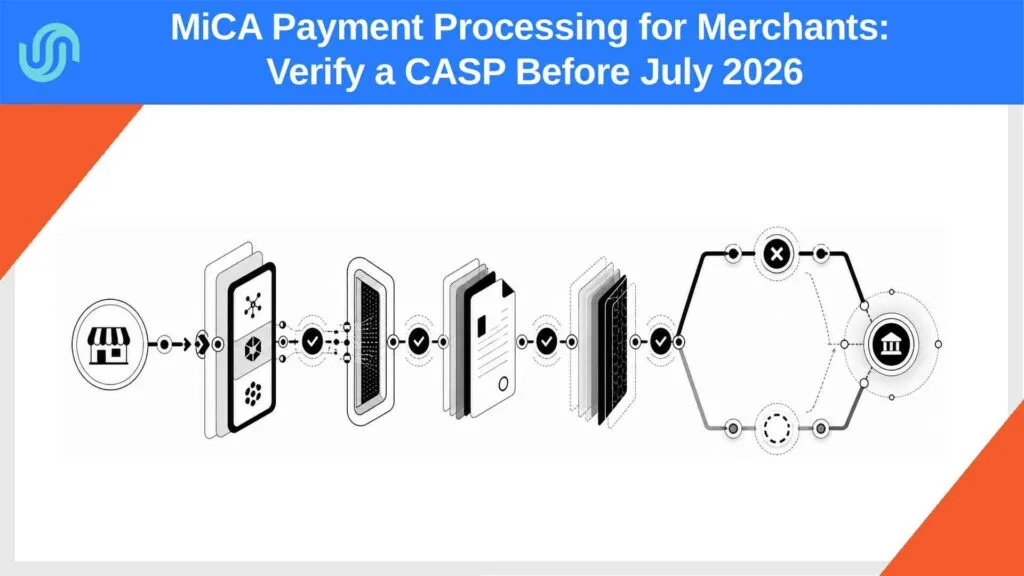
MiCA Payment Processing for Merchants: Verify a CASP Before July 2026
MiCA payment processing for merchants is becoming an immediate business-continuity issue for companies that rely on crypto acceptance, custody, conversion, settlement, on-ramps, or off-ramps in the European Union. The final EU-wide transitional period ends on July 1, 2026. Merchants should therefore verify which legal entity provides each crypto service, whether that entity is authorised for the required activity, and how funds and crypto-assets would move if a provider must stop serving EU clients.
This is not only a compliance question for crypto-asset service providers (CASPs). For an online merchant, a provider’s authorisation status can affect checkout availability, settlement timing, access to balances, customer refunds, treasury operations, and the ability to switch routes without interrupting sales.
What Happened
The European Securities and Markets Authority (ESMA) confirmed that the MiCA transitional period will expire across the EU on July 1, 2026. According to ESMA’s April 17, 2026 statement, an entity providing crypto-asset services to EU clients without a MiCA licence after that date will be in breach of EU law and must cease offering those services.
The transition has not been identical in every Member State. Article 143(3) of the Markets in Crypto-Assets Regulation allowed eligible providers operating under national law before December 30, 2024 to continue until July 1, 2026, until authorisation was granted or refused, or until an earlier national transition deadline.
ESMA expects unauthorised CASPs to implement orderly wind-down plans by July 1, including client notice and arrangements for transferring client crypto-assets to an authorised CASP or a self-hosted wallet. It also expects authorised CASPs to manage client migrations ahead of the deadline.
For merchants, the practical message is straightforward: an application in progress, a historical national registration, or a familiar brand name is not the same as confirmed MiCA authorisation for the service and entity being used.
Why It Matters for Online Merchants
Many merchants do not contract with a single provider for a single service. A crypto payment flow can involve a checkout provider, wallet or custodian, exchange, liquidity partner, stablecoin issuer, banking partner, and fiat off-ramp. Different group entities may perform different parts of that flow.
A merchant may not itself be a CASP merely because it accepts crypto. Whether MiCA authorisation is required depends on the activities and structure involved, so merchants should obtain qualified legal advice about their own model. However, every merchant relying on an external CASP has a commercial reason to verify that provider.
If a provider cannot continue an EU-facing service, possible effects include:
- suspension of crypto checkout or conversion;
- delayed or redirected settlement;
- additional onboarding before balances can be migrated;
- reduced access to custody, transfer, or exchange functions;
- customer refund and reconciliation complications;
- new reserve, volume, or geographic limits from replacement providers;
- urgent technical work to replace APIs, wallet addresses, or payout workflows.
Merchants using crypto as a backup rail should pay particular attention. A backup route that depends on an unauthorised provider may fail precisely when the primary payment route is under pressure.
Merchant Impact Analysis
MiCA payment processing for merchants
| Merchant dependency | MiCA deadline exposure | What to verify now |
|---|---|---|
| Crypto checkout and acceptance | Checkout may be paused if the serving entity cannot continue | Contracting entity, service scope, EU client coverage, and migration notice |
| Custody or hosted wallets | Access and transfer processes may change during wind-down | Asset ownership records, withdrawal rights, destination wallet controls, and transfer timing |
| Crypto-to-fiat conversion | Conversion or settlement route may become unavailable | Authorised entity, exchange service permission, liquidity route, and alternative off-ramp |
| Fiat on-ramp or off-ramp | Banking and compliance dependencies may change | CASP role, payment institution role, supported countries, and replacement onboarding |
| Merchant treasury and payouts | Balances or payout schedules may be disrupted | Balance limits, settlement frequency, safeguarding structure, and contingency instructions |
| Stablecoin settlement | Token, issuer, exchange, and custody risks may be concentrated | Supported token, redemption route, issuer status, custody provider, and fallback asset |
The most important distinction is between a provider brand and the legal entity actually delivering the service. Merchants should map the entity named in the contract, dashboard, invoices, settlement records, and terms of service. If those names differ, the provider should explain which entity performs each regulated activity.
Payment Risk and Underwriting Implications
Provider authorisation becomes a continuity control
Under MiCA Article 59, a person may not provide crypto-asset services in the EU unless authorised as a CASP or permitted to provide the relevant services under another qualifying financial-services status. Authorisations specify the crypto-asset services a provider may deliver.
Merchants should therefore verify more than whether a provider appears in a register. The authorised entity should match the contracting entity, and its permitted services should match the merchant’s actual use case, such as custody, transfer, exchange, or operating a trading platform.
Replacement onboarding may change commercial terms
A rushed migration can create underwriting pressure. A replacement provider may reassess the merchant’s countries, products, customer profile, transaction volumes, source-of-funds controls, refund practices, and licensing position. That review can produce new limits, reserves, settlement delays, or exclusions.
Merchants can reduce that risk by preparing an onboarding evidence pack before a migration becomes urgent. Useful materials include corporate documents, licences where applicable, policies, transaction history, flow-of-funds diagrams, wallet controls, screening procedures, refund rules, and recent provider statements.
Wind-down does not eliminate operational risk
MiCA includes client-protection and orderly-transfer requirements. For example, Article 64 requires procedures for timely and orderly transfer of client crypto-assets and funds when authorisation is withdrawn. Still, a legally orderly transfer can involve operational delays, manual checks, changed wallet instructions, or reconciliation work for a merchant.
Merchants should not assume that regulation guarantees uninterrupted service, approval by another provider, immediate withdrawals, or unchanged pricing.
Strategic Considerations About MiCA Payment Processing for Merchants
Build a legal-entity service map
Document every provider involved in crypto acceptance and settlement. For each one, record the legal entity, jurisdiction, contracted service, downstream dependencies, balance exposure, settlement frequency, and replacement route. This extends the provider-selection discipline described in WiseAlt’s guide to crypto merchant services.
Verify authorisation using official sources
ESMA publishes an Interim MiCA Register covering authorised CASPs and non-compliant entities. Check the register and, where necessary, the relevant national competent authority. Save dated evidence of the result and ask the provider to explain any mismatch.
Do not rely only on statements such as “MiCA ready,” “licence pending,” or “regulated in Europe.” Ask for the exact legal entity, authorisation status, permitted services, home Member State, and expected position on July 1, 2026.
Separate migration from emergency failover
A migration plan moves balances, customers, data, and integrations in a controlled sequence. A failover plan keeps critical payment or settlement functions available during an outage. Merchants need both.
For businesses using several rails, a multi-provider payment gateway can support routing resilience, but it does not replace provider-level due diligence or guarantee that a crypto route is legally and operationally available.
Limit concentration
Review how much value and how many functions depend on one provider group. Using one group for custody, conversion, settlement, and banking may simplify operations but can increase the impact of a licence, banking, or risk-appetite change. WiseAlt’s overview of crypto on-ramps and off-ramps explains why the full fiat-to-crypto path matters.
Practical MiCA Merchant Checklist
| Priority | Merchant action | Evidence to retain |
|---|---|---|
| Immediate | Identify every legal entity involved in EU crypto flows | Contracts, terms, invoices, dashboard entity names, and flow diagram |
| Immediate | Check the entity and required service in official registers | Dated register extract, national-register result, and provider confirmation |
| Immediate | Ask for the provider’s July 1 service-continuity position | Written confirmation, licence reference, service scope, and affected countries |
| High | Request the wind-down and migration process | Notice periods, balance-transfer method, withdrawal steps, fees, and support contacts |
| High | Prepare a replacement-provider onboarding pack | Corporate, compliance, licensing, transaction, and source-of-funds documents |
| High | Test withdrawal, settlement, and reconciliation processes | Test records, settlement timing, wallet whitelists, and exception procedure |
| Medium | Set exposure and concentration limits | Maximum provider balance, sweep frequency, and escalation thresholds |
| Medium | Rehearse a controlled failover | Owners, decision triggers, API changes, customer messaging, and reconciliation steps |
Merchants should also review their customer communications. If a migration changes supported assets, wallet addresses, refund methods, fees, processing times, or the identity of a service provider, customer-facing terms and operational instructions may need updating.
Related Industry Trends
MiCA is part of a wider shift toward continuous scrutiny of payment and crypto-provider relationships. Regulators increasingly expect clear governance, business-continuity planning, client-asset controls, and credible operational processes. Providers, banks, and acquirers may translate those expectations into more detailed merchant onboarding and ongoing reviews.
At the same time, merchants are adding crypto to broader payment stacks rather than treating it as an isolated channel. Secure integration, wallet controls, conversion logic, and settlement design remain important; WiseAlt covers these issues in its guide to a crypto payment gateway for high-risk industries.
The durable lesson extends beyond the July deadline: provider authorisation, service scope, and exit readiness should be monitored throughout the relationship, not checked only during onboarding.
Conclusion
The July 1, 2026 MiCA deadline turns CASP verification into a time-sensitive payment-continuity task related to MiCA payment processing for merchants. Merchants should identify the legal entities behind each crypto service, verify authorisation and service scope using official sources, understand wind-down arrangements, prepare replacement onboarding evidence, and test backup settlement routes.
WiseAlt helps merchants identify, compare, and coordinate payment providers and backup rails. For businesses reviewing EU crypto acceptance or settlement, the Payments for Crypto and Web3 page outlines how WiseAlt approaches provider selection and payment continuity. WiseAlt does not provide legal advice, act as a CASP, or guarantee provider approval; merchants should obtain qualified legal advice for their regulatory position.