Home » Smart routing | cascading payments

Smart routing | cascading payments

Content on smart routing | cascading payments for high-risk merchants (iGaming, betting, FX/CFD, crypto, adult). We cover multi-acquirer/orchestrator setups; BIN/issuer country/product-type and amount-based routing; health checks and latency SLAs; soft- vs hard-decline handling; timed retries with idempotency; PSD2 SCA/3DS strategy (frictionless vs challenge); local vs cross-border acquiring; cascading payments; routing logic PSP, psp failover, transaction approval optimization, high-risk payment routing; and failover to APMs when cards are restricted. Goal: lift approval rates and stability without breaching network rules or merchant risk tolerances. WiseAlt focuses on high-risk sectors, so this tag aligns with our scope.

Authoritative outbound resources related to Smart routing | cascading payments:

  • Visa — Authorization & reversal processing best practices (CNP auth optimization fundamentals). Visa

  • Mastercard — Transaction Processing Rules (reference for approval/decline handling & compliance). Mastercard

  • Mastercard Gateway insights — improving CNP approval and optimizing authorization rates. Mastercard

  • EMVCo — Deploying EMV® 3-D Secure (frictionless/challenge flows that influence routing/cascading decisions). EMVCo

  • EBA (EU) — PSD2/RTS & SCA guidance/exemptions affecting retry and 3DS strategies. European Banking Authority

  • Visa — Anti-enumeration best practices (to avoid abusive retries that trigger issuer defenses). Visa

ACH recurring adult subscriptions: Nacha-friendly flows, lower fees, fewer declines

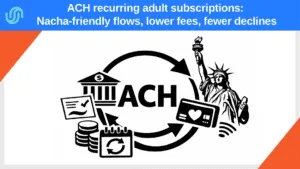
Illustration of ACH recurring payments for adult subscriptions in the USA with a recurring cycle, bank transfer icons

For adult and dating merchants in the U.S., card acquiring is usually the primary rail—but ACH recurring adult subscriptions can be a smart secondary rail for certain segments: lower fees, fewer “card expired” failures, and sometimes better long-term retention.

The key is doing it in a Nacha-friendly way, with clear authorization language, mandate storage, and returns management.

ACH recurring adult subscriptions: Nacha-friendly flows, lower fees, fewer declines Read More »

iGaming Payment Gateway: MSB/EMI/PSP + Orchestration for Routing, Cascading and Multi-PSP Control

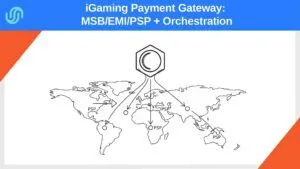
Illustration with a simplified world map, gateway hub, and payment flows showing cascading across multiple PSP nodes, representing iGaming multi-geo orchestration.

An iGaming payment gateway strategy often fails when it becomes “PSP sprawl”: too many dashboards, fragmented risk rules, inconsistent retries, and limited visibility across geographies. Payment orchestration solves this by putting routing, cascading, limits, and unified reporting under one control layer. For enterprise iGaming, the key is not adding yet another provider; it’s building a governance model that can measure performance, switch traffic quickly, and preserve audit trail across partners and payment methods. In the EU, authorization and registration expectations under PSD2 and related EBA guidance influence how payment institutions should present their controls and processes.

iGaming Payment Gateway: MSB/EMI/PSP + Orchestration for Routing, Cascading and Multi-PSP Control Read More »

From Agent to Owner: How to Buy a Canadian MSB and Own Your Tech Stack

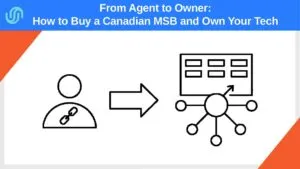
Illustration showing an agent icon transforming into a control dashboard connected to a gateway hub and multiple PSPs, representing the move from commissions to orchestration when buys Canadian MSB.

The traditional high-risk merchant account referral model has a glass ceiling. As an agent or ISO, you can introduce high-quality merchants to processors all day, but you remain at the mercy of the “upstream” provider. You cannot systematically control routing, partner performance, or the cascading logic that determines your approval rates. To break this cycle, the most strategic move for scaling an ISO business in 2026 is to move toward owning your payment stack for ISOs. By choosing to buy a Canadian MSB (Money Services Business) or other licensed entity (EMI/PSP) and pairing it with a proprietary gateway, you transition from a simple middleman to a full-scale platform owner. This guide serves as your ISO to PayFac transition guide, showing you exactly how to reclaim your margins and operational independence.

From Agent to Owner: How to Buy a Canadian MSB and Own Your Tech Stack Read More »

Selling an MSB / EMI / PSP: Why Bundling a Gateway Increases Valuation

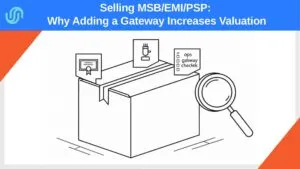
Illustration of a deal package with license document, gateway diagram, and checklist plus a magnifying glass, representing buyer-ready MSB/EMI/PSP sales.

Selling an MSB, EMI, PSP or any payment processing assets sell faster when buyers can see a complete operating system—not only a legal entity. A license-only sale forces the buyer to rebuild integrations, routing rules, dashboards, logs, reconciliation, and access controls, which creates valuation drag and longer closing cycles. Bundling a payment orchestration gateway shifts the conversation from “paper” to “product”: you can demonstrate routing and cascading, operational reporting, and an audit trail. For MSB sellers targeting international buyers, it also helps answer the first diligence question: “Can we operate compliantly on day one?” For Canada-facing MSBs, the buyer will also look for evidence that registration and obligations are understood and that operational record keeping can be supported.

Selling an MSB / EMI / PSP: Why Bundling a Gateway Increases Valuation Read More »

Buy/Sell MSB or EMI/PSP with Payment Gateway as Resellable Payment Orchestration Stack

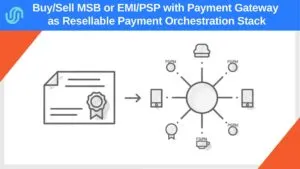
Illustration showing a license document connected to a payment gateway hub with multiple PSP/APM nodes, representing buy/sell MSB/EMI/PSP deal.

A high-risk payment gateway can turn an MSB or licensed EMI/PSP transaction from a “license-only handover” into a scalable, resellable payments business. Buyers don’t just want a legal wrapper—they want a working operating engine: routing, cascading, reporting, logs, and a clear onboarding workflow that can survive audits and partner due diligence. This matters across three groups: (1) MSB/EMI sellers and resellers who want higher liquidity and valuation, (2) agents and ISOs moving beyond commission-only models into payment orchestration or Merchant of Record, and (3) enterprise iGaming operators managing many PSPs/APMs across multiple geographies. In short: the gateway is the product layer you can monetize, improve, and eventually sell as a complete business.

Buy/Sell MSB or EMI/PSP with Payment Gateway as Resellable Payment Orchestration Stack Read More »

Cross-border declines US cards: causes, fixes, and routing that actually works

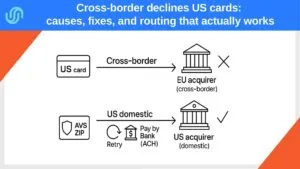
flowchart: US card → EU acquirer (cross-border, X) vs US acquirer (domestic, ✓); AVS ZIP, retry logic, Pay by Bank (Plaid/ACH).

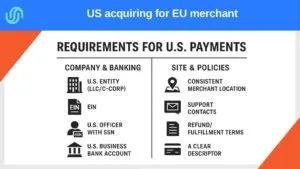
A European online project gets a rush of US buyers… and approvals sag, i.e. cross-border declines US cards: causes, fixes, and routing that actually works. That’s the classic cross-border decline pattern: the issuer sees “US cardholder → non-US merchant/acquirer,” becomes stricter, and says no. The cure isn’t one trick—it’s better data, smarter retry logic US issuers, and (when warranted) local routes or US-native rails.

Cross-border declines US cards: causes, fixes, and routing that actually works Read More »

Multi-Provider Payment Gateway: Reducing Declines with Smart PSP Orchestration

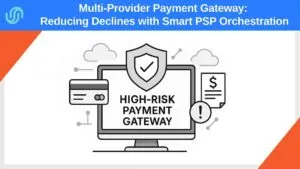
Illustration of a high-risk payment gateway with smart PSP orchestration showing card, warning icon, and security shield on a monitor.

Declined payments are more than a technical glitch — they’re lost conversions, frustrated users, and lower LTV. In high-risk industries like iGaming, dating, crypto, and Forex, decline rates can easily exceed 30%, especially when relying on a single PSP. That’s why leading merchants are adopting multi-provider payment gateway architectures powered by smart PSP orchestration platforms. These systems intelligently route transactions, apply fallback logic, and monitor performance — all with one goal: decline rate optimization.

In this article, we show how to reduce failed payments using orchestration strategies and real-world routing logic, without rebuilding your stack.

Multi-Provider Payment Gateway: Reducing Declines with Smart PSP Orchestration Read More »