
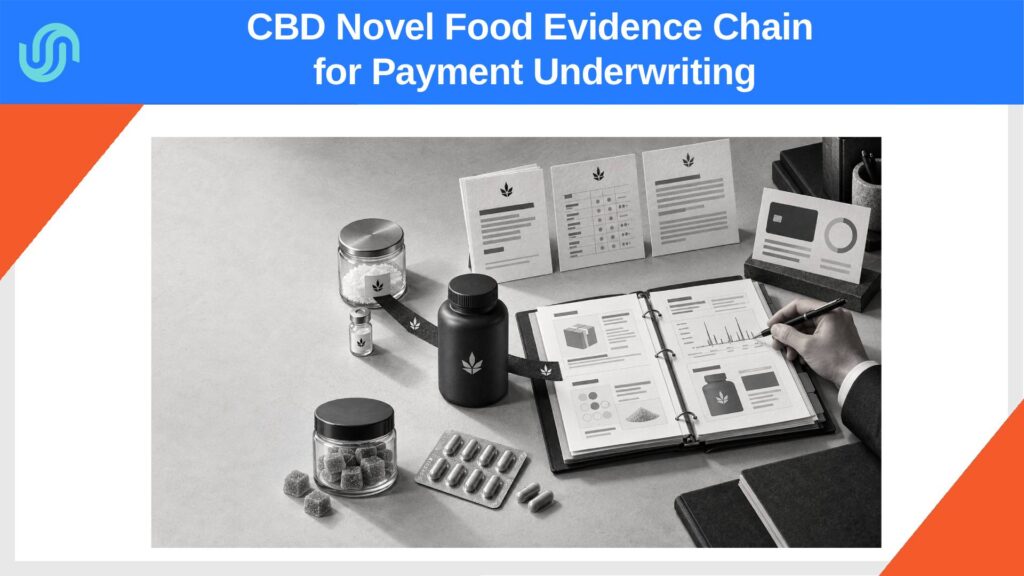
UK CBD novel food payment processing is entering a more evidence-sensitive phase. In a paper prepared for its September 2026 Board meeting, Food Standards Agency (FSA) officials proposed recommending that ministers in England and Wales authorise three high-purity cannabidiol (CBD) novel foods. The published paper is not a final ministerial authorisation, and the official material reviewed on 3 October 2026 did not establish that the Board had approved the proposal or that the advice had been submitted to ministers. It also does not turn every finished product linked to an application into an authorised product.
What Happened in UK CBD Novel Food Regulation
The FSA’s September 2026 Board paper covers three applications: RP 7 for synthetic CBD, RP 350 for CBD isolate and RP 427 for isolated CBD derived from hemp. Each concerns a high-purity ingredient containing at least 98% CBD. The paper says the applications received positive safety opinions and asks the Board to agree that proposed recommendations to authorise them, subject to stated conditions, are suitable for presentation to ministers.
The final decision rests with ministers in England and Wales. At the time of this article’s research on 3 October 2026, the canonical FSA material reviewed for this article did not establish that a final ministerial authorisation had taken effect. Merchants should therefore verify the current position in the official regulated-products records immediately before making a product, onboarding or marketing decision.
The proposed conditions matter. The applications were assessed for adults at a maximum dose of 10 mg CBD per day. The FSA also proposed labelling about that provisional acceptable daily intake and warnings for under-18s and other vulnerable groups. The permitted food categories are application-specific: all three include food supplements, while RP 350 also includes certain beverage and confectionery uses.
The FSA paper also says that authorisation would apply only to the specified novel food when it meets the relevant terms. It would not create a blanket approval for CBD, for a brand’s entire catalogue or for every formulation associated with an applicant.
Recommendation, Public List and Authorisation Are Different
Merchants should keep three records separate.
| Record | What it indicates | What it does not prove |
|---|---|---|
| Proposed FSA Board recommendation | FSA officials asked the Board to agree that recommendations on specified applications were suitable for presentation to ministers | That the Board agreed, final advice was submitted, ministers made a decision, or an authorisation is in force |
| England and Wales CBD Public List | A named product is linked to an application that is validated or awaiting evidence and may remain on the market under the FSA’s interim enforcement approach | Formal authorisation, FSA endorsement or guaranteed future authorisation |
| Final authorisation and register entry | The specified novel food is authorised under stated identity, production, use, dose and labelling conditions | Automatic coverage for a different ingredient, process, formulation, supplier or finished product |
The FSA’s CBD guidance for England and Wales states that validation is not authorisation. The CBD Public List likewise explains that enforcement decisions remain with local authorities and that list inclusion is an interim status, not an endorsement.
Why UK CBD Novel Food Status Matters for Online Merchants
Regulatory evidence and payment underwriting meet at the product level. A processor or acquiring partner may ask what the merchant sells, where it sells, who manufactures the CBD ingredient, which application covers it and whether the label and dosage match the supported conditions. A general claim that a supplier is “on the list” may be too weak if the exact stock-keeping unit, formulation or brand relationship cannot be traced.
The September proposal, and any later Board or ministerial decision, may make documentary differences more visible. Merchants linked to one of the three applications may need to show that their ingredients and finished products fit the eventual terms, if ministers authorise them. Merchants linked to other applications should not imply that the first proposal covers them. Businesses selling broad-spectrum, full-spectrum or lower-purity products should be especially careful not to borrow the status of the three ≥98% applications.
This does not mean that the FSA announced a payment-network rule or that a provider must approve or terminate a merchant. It means the underlying product evidence is changing, and providers may reassess regulatory, misrepresentation, refund and continuity risks in their own underwriting.
UK CBD Novel Food Merchant Impact Analysis
Ingredient-to-product traceability becomes more important
A defensible file should connect the finished product to the exact ingredient supplier and application. Useful evidence may include supplier agreements, invoices, batch certificates of analysis, formulation records, product labels and the relevant Public List entry. Names and identifiers should agree across the documents.
Catalogue claims need tighter control
Merchants should avoid calling a product “authorised” merely because its ingredient application was recommended or because a related item appears on the Public List. Marketing, product pages, checkout copy and onboarding answers should all use the same accurate status.
Conditions may affect product design
If ministers authorise the applications, the binding terms—not the headline—will determine permitted uses. Dose, category, purity, controlled-cannabinoid specifications and warnings may affect which formulations can rely on the authorisation. A merchant should not assume that an ingredient authorisation automatically validates a finished gummy, drink, oil or capsule.
Geography must be explicit
The FSA recommendation concerns advice to ministers in England and Wales. Food Standards Scotland advises Scottish ministers through its own process. Northern Ireland has a distinct route under the Windsor Framework, although eligible GB-authorised goods may have a route through the Northern Ireland Retail Movement Scheme. A single “UK compliant” field in a product or underwriting database may hide material differences.
UK CBD Novel Food Payment Risk and Underwriting Implications
For a broader view of sector-specific acquiring and continuity, see WiseAlt’s payments for CBD, hemp and nutraceutical businesses. The immediate operational issue is not a new card rule; it is whether the merchant can give a payment partner a consistent, current and product-specific evidence pack.
| Risk area | Likely underwriting question | Merchant control |
|---|---|---|
| Product status | Is this exact product linked to the stated application or authorisation? | Maintain a SKU-to-application matrix with official links and dated checks |
| Supply chain | Does the finished product use the named ingredient and approved production route? | Retain contracts, invoices, batch records and certificates of analysis |
| Marketing | Do claims overstate authorisation, safety or health effects? | Review website, advertising, labels and support scripts together |
| Territory | Is the product being sold under the correct national regime? | Apply country-specific catalogue and fulfilment rules |
| Change control | Did the dose, supplier, formula, label or application status change? | Require compliance approval before catalogue or supplier changes |
| Continuity | Could a status change interrupt acquiring or settlement? | Keep provider communications, a cash-flow buffer and a tested contingency plan |
CBD merchants can also use WiseAlt’s guides to a CBD merchant account, high-risk payment processing and high-risk PSP selection when structuring provider due diligence.
Reserves, settlement delays or enhanced reviews are commercial decisions made by individual providers. Merchants should ask providers to state their evidence requirements and change-notification rules in writing rather than treating any likely response as universal.
Strategic Considerations
Build a product-status ledger
Create one controlled record for each SKU showing its market, application number, Public List status, ingredient supplier, manufacturing route, CBD content per serving, label version and last verification date. Store the canonical source URL and a dated copy of the evidence reviewed.
Separate regulatory status from commercial approval
An authorised ingredient does not guarantee payment acceptance. Conversely, a provider’s willingness to process payments does not establish food-law compliance. Keep legal/product review and payment-provider approval as separate gates.
Plan for both a positive decision and delay
If ministers approve the applications, merchants will need to compare their products with the final terms and effective date. If the decision is delayed or the terms differ from the recommendation, merchants may need to maintain the interim evidence position. Avoid campaign launches or stock commitments that depend on an unverified effective date.
Control representations by affiliates and distributors
Third parties can create underwriting exposure by using words such as “approved,” “legal” or “authorised” too broadly. Give resellers approved status language and monitor high-traffic claims, especially when a regulatory milestone generates press coverage.
UK CBD Novel Food Merchant Checklist
- Check the FSA recommendation and then verify whether ministers have issued a final decision.
- Check the official records for RP-7, RP-350 and RP-427; record each status, phase, check date and any final authorisation conditions. Do not rely on a supplier screenshot alone.
- For England and Wales, match every marketed SKU against the Public List and retain the product identifier, application number, status and check date.
- Confirm that supplier names, invoices, formulation records and certificates of analysis form an unbroken evidence chain.
- Compare CBD dose, food category, purity, manufacturing method, controlled-cannabinoid limits and warnings with any final terms of authorisation.
- Remove wording that treats a recommendation, validation or Public List entry as final authorisation.
- Apply separate controls for England and Wales, Scotland and Northern Ireland.
- Send the updated evidence pack to each payment provider and ask whether any underwriting record, reserve or settlement term needs review.
- Log regulatory and supplier changes through a formal catalogue-change process.
- Prepare customer-service and refund scripts for products that may need relabelling, restriction or withdrawal.
UK CBD Novel Food Industry Trends
The first three applications placed before the FSA Board for proposed recommendation concern high-purity CBD and application-specific conditions. The same board paper reports additional positive safety assessments for other high-purity applications, but those applications still require their own decisions. This points toward a staged market transition rather than one universal approval event.
The wider direction is toward more granular records: ingredient identity, production method, dose, category, warnings and territory. That aligns with a broader underwriting preference for verifiable product data instead of category-level assurances. Merchants that make this information easy to audit are better placed to answer reviews quickly, even though no evidence pack can guarantee approval.
Conclusion
The September 2026 Board paper is an important procedural step, not the end of the CBD novel-food process. UK CBD novel food merchants should distinguish a proposed recommendation from a Board outcome and ministerial decision, distinguish Public List status from authorisation and connect every finished product to its precise supporting evidence.
WiseAlt helps high-risk merchants identify, compare and coordinate payment providers, prepare onboarding evidence and design payment-continuity options. It does not provide legal advice or guarantee approval. Contact WiseAlt to review how your product-status evidence maps to provider onboarding questions and payment-continuity planning.