
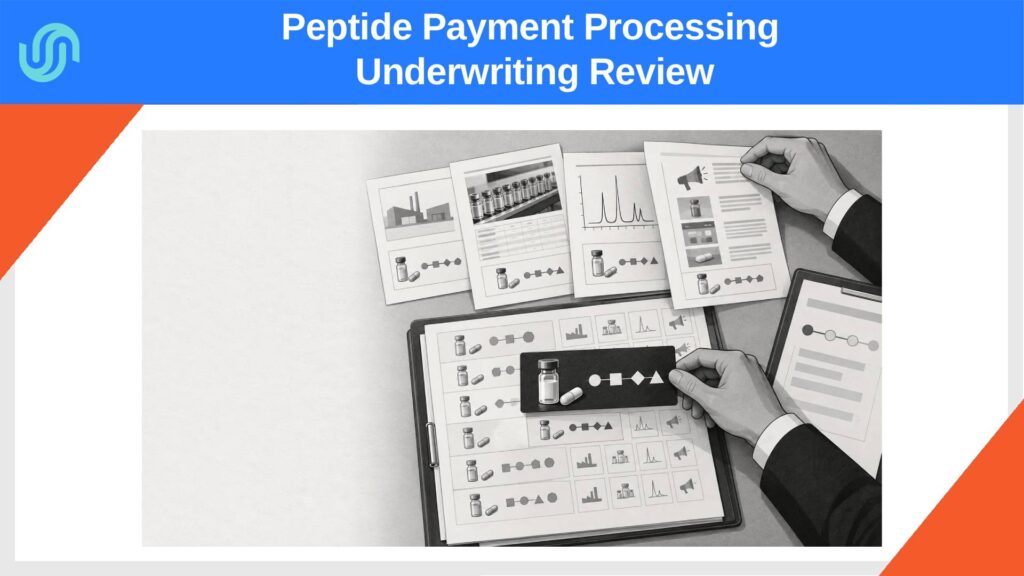
Peptide payment processing is entering a more evidence-intensive phase after the U.S. Food and Drug Administration reviewed seven peptide families for potential inclusion on the section 503A Bulks List in July 2026. The immediate issue is not a new card-network rule or an automatic ban on every peptide merchant. It is a sharper regulatory signal: online sellers, pharmacies and wellness businesses should expect payment underwriters to look beyond a certificate of analysis and examine each product’s legal basis, claims, supply chain and sales model.
What happened in the FDA’s peptide review?
On July 23 and 24, 2026, the FDA’s Pharmacy Compounding Advisory Committee discussed the free-base and acetate forms of BPC-157, KPV, TB-500, MOTS-c, Emideltide, Epitalon and Semax. The FDA meeting record identifies the uses evaluated, including ulcerative colitis for BPC-157, wound healing for TB-500, obesity and osteoporosis for MOTS-c, and insomnia for Epitalon.
In its briefing package, the FDA proposed that all 14 forms considered—the free base and acetate form of each peptide family—should not be included on the 503A Bulks List. That wording matters. FDA advisory committees provide independent, non-binding recommendations, and the meeting itself did not create a universal prohibition covering all peptides, all compounded products or every merchant. A final regulatory outcome may require further agency action and rule-making.
The BPC-157 record shows why the review is commercially significant. The FDA reported that neither BPC-157 free base nor BPC-157 acetate has an applicable USP or National Formulary drug-substance monograph and neither is a component of an FDA-approved drug. Its BPC-157 presentation also cited limited clinical safety information, unresolved characterization and impurity questions, and potential immunogenicity risk. FDA concluded that the balance of its evaluation criteria weighed against adding the two forms to the 503A list.
Why the 503A status matters
Section 503A does not make “compounded” a general exemption from drug regulation. According to the FDA’s official 503A explanation, state-licensed physicians and pharmacists operating under section 503A may use a bulk drug substance only when the relevant conditions are satisfied. In simplified form, the substance must meet an applicable USP or NF monograph, be a component of an FDA-approved drug when no such monograph exists, or appear on the 503A Bulks List when neither of the first two routes applies. Additional conditions also apply.
This is a product-by-product and operating-model question. An FDA-approved peptide drug, a patient-specific compounded prescription, a dietary supplement, a cosmetic, and a vial promoted as “research use only” do not become equivalent merely because all are described with the word peptide. The product’s composition, intended use, claims, route of administration, dispensing model and seller’s role all affect the analysis. Merchants should obtain qualified U.S. legal and regulatory advice rather than infer status from a competitor’s website or supplier documentation.
Why it matters for online merchants and payment providers
Payment providers are not the FDA, and the FDA’s July review did not instruct acquirers to decline peptide merchants. Even so, providers must decide whether a merchant’s activity fits their risk appetite and whether the submitted business description matches what customers can actually buy. For regulated-product e-commerce, uncertainty can lead to more questions, higher reserves, volume limits, delayed approval or rejection.
Peptide sellers therefore fit within the broader challenge described in WiseAlt’s payments for CBD, hemp and nutraceutical businesses hub: onboarding depends on product claims, fulfillment, refund practices, geographic restrictions and transparent disclosure. A merchant that submits a generic “wellness” description while its website promotes injectable products for disease treatment creates an avoidable mismatch.
Merchant impact analysis
| Merchant model | Likely underwriting focus | Evidence to prepare |
|---|---|---|
| Licensed pharmacy or clinical model | Licensure, prescriber relationship, patient-specific workflow, compounding basis and permitted jurisdictions | Licences, pharmacy policies, prescription flow, product matrix, legal analysis and supplier records |
| Wellness or nutraceutical store | Whether ingredients and claims fit the stated product category | Labels, ingredient files, substantiation for claims, fulfilment records and refund policy |
| Research-product seller | Whether website content, affiliates, testimonials and checkout behaviour contradict the research-use positioning | Customer restrictions, marketing controls, channel monitoring, terms and documented prohibited uses |
| Marketplace or multi-product seller | Control over third-party listings, prohibited products, seller verification and complaint handling | Seller onboarding rules, catalogue monitoring, takedown process and transaction-level product data |
The practical lesson is not to search for a processor that asks fewer questions. It is to make the business easier to understand and accurately underwrite. WiseAlt’s guide to choosing a high-risk merchant account and payment gateway explains why approval quality depends on the fit among business model, provider, acquiring route and risk controls.
Payment risk and underwriting implications
1. Product eligibility and product identity
A certificate of analysis can help establish what a supplier tested, but it does not by itself establish that the product may lawfully be compounded, marketed or sold for a particular use. The July FDA materials also highlight naming and characterization problems: different salts, derivatives or active moieties may be marketed under the same common name. The merchant’s product matrix should identify the exact substance, form, manufacturer, route of administration, intended use and jurisdiction of sale.
2. Claims across every sales channel
Underwriters may compare the product page with ads, social posts, affiliate pages, email campaigns and testimonials. A “research use only” disclaimer is unlikely to resolve a contradictory customer journey that describes dosage, therapeutic effects or human consumption. Product naming should also remain consistent across supplier records, labels, checkout and the underwriting application. The practical lesson is to review claims and catalogue data before submitting an application, not after a provider flags them.
3. Disclosure and enforcement history
A separate July 2026 enforcement event shows the cost of false representations. The U.S. Department of Justice reported that the operators of Paradigm Peptides were sentenced after pleading guilty to introducing unapproved new drugs into interstate commerce with intent to defraud and mislead. The DOJ release says the business sold peptides, SARMs, hCG and other products and made false statements about licensing, manufacturing, testing and FDA approval. Those case-specific facts should not be generalized to the entire sector, but they show why unverifiable representations are a major underwriting concern.
4. Transaction and fulfilment risk
Regulatory questions interact with ordinary payment risk. Long shipping times, cold-chain failures, vague descriptors, difficult cancellations, continuity billing and aggressive performance claims can all increase refunds and disputes. Providers may respond with rolling reserves, settlement delays, transaction caps or monitoring conditions. A sound high-risk payment processing plan should address both regulatory fit and measurable payment performance.
A practical peptide merchant underwriting file
Before applying for a merchant account or asking an existing provider to approve a new peptide product, prepare a version-controlled file containing:
- A product matrix: exact ingredient or substance, form, concentration, route of administration, intended use, customer type and destination market.
- A regulatory basis: a product-specific assessment from qualified counsel or an appropriate compliance specialist, including the seller’s and fulfilment partner’s roles.
- Licensing evidence: relevant pharmacy, practitioner, facility and state licences, with expiry dates and permitted activities.
- Supplier and quality records: manufacturer identity, FDA establishment registration where required, batch records, certificates of analysis and recall procedures.
- A claims register: approved wording for product pages, ads, affiliates, email, social media and customer-support scripts, with an owner and review date.
- The customer journey: prescription and identity checks where applicable, consent, checkout, descriptor, cancellation and refund flows.
- Fulfilment controls: shipping territories, delivery tracking, temperature controls where relevant, lost-order handling and customer support service levels.
- Payment evidence: recent processing statements, refund and chargeback ratios, reason-code analysis, fraud controls, average ticket and expected monthly volume.
- Change control: a rule that prevents new substances, claims, subscription terms or sales countries from going live before compliance and provider review.
The provider should receive the same material that reflects the live website. Omitting a disputed product or splitting it onto an undisclosed domain may turn an approval problem into a misrepresentation problem.
Strategic considerations for peptide payment processing continuity
A backup processor is not permission to route prohibited or undisclosed transactions. Payment resilience starts with providers that knowingly accept the disclosed model and with contracts that clearly define approved products, countries and volume. Merchants should also understand reserve terms, termination rights, settlement timing and the process for adding a new SKU.
For businesses with significant revenue concentration, a structured payment infrastructure due-diligence review can map single-provider dependency, gateway portability, token ownership, reserve exposure and operational fallback. Any secondary route should be approved for the same underlying products and claims; otherwise, apparent redundancy may fail precisely when it is needed.
Merchants comparing providers should ask who performs the underwriting, which acquiring entity will hold the merchant relationship, whether peptide or compounded-product sales are expressly permitted, how website changes are monitored and what triggers re-underwriting. WiseAlt’s guide on choosing a payment processor for a high-risk business provides a broader selection framework.
Related industry trend: product-level evidence is replacing category labels
The FDA review and recent enforcement actions point in the same operational direction even though they are legally distinct: broad labels such as “wellness,” “nutraceutical” or “research” are not substitutes for a defensible product file. Payment providers increasingly need to understand exactly what is sold, how it is promoted, who fulfils it and why the seller believes the activity is permitted.
That shift can benefit well-prepared merchants. A transparent product matrix and controlled claims process allow providers to separate a licensed, documented model from an opaque catalogue. It also makes future product launches easier to review without forcing the entire payment relationship back to the beginning.
Conclusion
The FDA’s 2026 peptide review does not create one payment rule for the entire peptide market. It does raise the standard of evidence that a serious merchant should be ready to provide. The most resilient approach is to validate each product’s status, align every marketing claim with that analysis, disclose the full model to payment partners and design continuity around approved—not hidden—activity.
WiseAlt is a payment solutions advisor, not a law firm, regulator, acquirer or guarantor of approval. If your peptide, compounding or wellness business needs help organizing its payment profile, comparing provider requirements and assessing backup infrastructure, contact WiseAlt. Obtain separate advice from qualified legal and regulatory professionals for product eligibility and healthcare compliance.