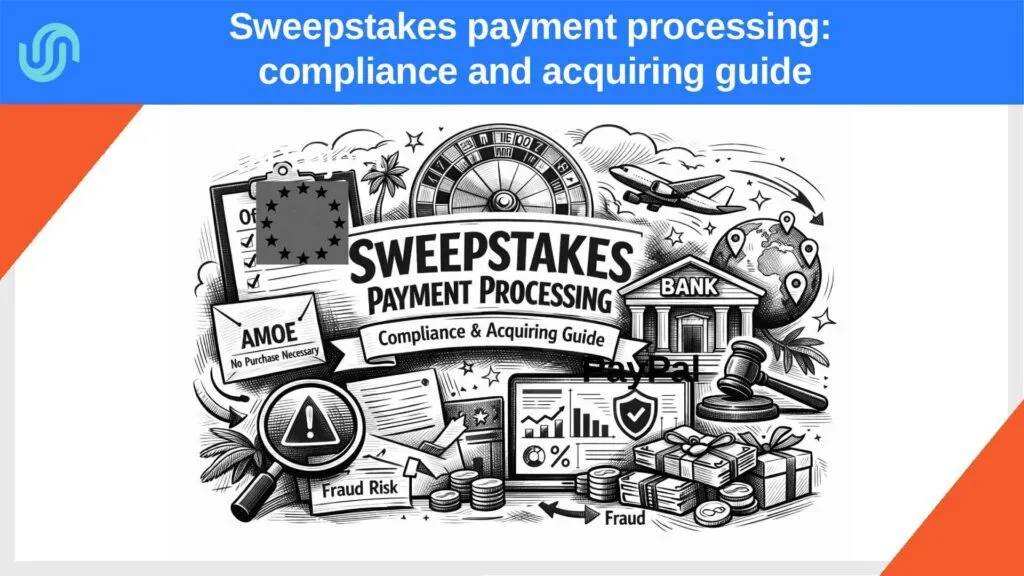
Sweepstakes can be a fast, scalable growth lever for online merchants—email capture, referrals, reactivation, and product launches. But sweepstakes also sit on a thin compliance line, and payment partners often treat them as high-scrutiny because a “nearly correct” promo can quickly look like an illegal lottery (or even gambling-like activity) once you add payments, subscriptions, affiliates, and cross-border traffic. This guide explains how to structure and document a sweepstakes so your sweepstakes payment processing can be approved, monitored, and scaled—without avoidable chargebacks, fraud, or sudden shutdown risk.
Disclaimer: This is informational content, not legal advice. Requirements vary by country, state/province, prize pool size, and your specific mechanics.
Sweepstakes payment processing: what a sweepstakes is (and what it is not)
A sweepstakes is a promotional giveaway where prizes are awarded by random chance, not skill. To avoid being treated as an illegal lottery, legitimate sweepstakes typically include a free method of entry (“No Purchase Necessary” / AMOE) and a clear statement that purchase does not increase chances of winning.
Sweepstakes are often confused with:
- Contests (skill-based competitions)
- Lotteries (typically regulated/authorized only under specific rules and licensing)
Sweepstakes payment processing: not all “sweepstakes” are the same (promo vs casino-like models)
In practice, merchants use the word “sweepstakes” for two very different models:
- Marketing sweepstakes: a classic, limited-time giveaway tied to lead generation or customer engagement, with a genuine free entry route (AMOE).
- Casino-like sweepstakes (“sweepstakes casinos”): casino-style gameplay with virtual currencies and prize redemption mechanics.
The second model receives significantly higher scrutiny from both regulators and acquirers, because it can be viewed as gambling in substance even if it relies on sweepstakes-style legal arguments.
Sweepstakes payment processing: the legal triangle (Prize + Chance + Consideration)
A common compliance framing is the “triangle”:
- Prize (something of value)
- Chance (random selection)
- Consideration (payment or meaningful value required to enter)
If all three are present, the promotion can be treated like a lottery in many jurisdictions—often illegal without specific authorization. “No Purchase Necessary” isn’t just fine print: it must be real, accessible, and consistent across ads, landing pages, and rules.
Underwriting tip: acquirers don’t only want text—they want proof. Keep screenshots or short recordings of the AMOE path and disclose it clearly.
Sweepstakes payment processing: US requirements that commonly appear in underwriting
In the US, many sweepstakes can be run without a gambling license if you remove consideration via a genuine free entry route and provide clear rules and disclosures. However, some states impose extra requirements once prize pools exceed thresholds.
Example (New York): the NY Department of State states that promotions offering prizes “in excess of five thousand dollars” determined by chance, “without any consideration,” must file a registration with contest rules/odds and related information.
What underwriters usually request (US):
- Final Official Rules
- AMOE details + screenshots of the free entry route
- Ad creatives + landing page URLs (to verify disclosures)
- Prize fulfillment proof (vendor, timeline, process)
- Support and refund workflows (SLA, contact channels)
Sweepstakes payment processing: a real enforcement snapshot (what can trigger shutdown risk)
Regulatory posture is not theoretical. New York’s Attorney General has explicitly targeted “online sweepstakes casino” models, arguing that many are illegal in New York where users “stake or risk something of value” with cash/prize-like redemption mechanics. For merchants, this translates into a practical acquiring risk: if your model resembles casino gameplay with redeemable value, expect heightened review, GEO restrictions, and potential sudden partner exits.
Sweepstakes payment processing: UK perspective (free draws, prize competitions, and “no approval”)
In the UK, “free draws and prize competitions” have a defined compliance boundary. The UK Gambling Commission explicitly states it does not approve free draws or prize competitions, and may raise concerns if it sees issues.
The UK advertising regulator’s guidance also clarifies that a free entry route must be charged at the normal rate (no extra payment beyond what it normally costs to use that communication method), and must be explained clearly and prominently.
Sweepstakes payment processing: Canada essentials (disclosure obligations and common validation patterns)
Canada is often stricter in practice. The Competition Bureau provides enforcement guidance for promotional contests and highlights required disclosures like the number and approximate value of prizes, and other material information.
Many Canadian promotions also include winner validation steps commonly seen in market practice (often including a “skill-testing question”), especially where organizers want to reduce “pure chance” characterization—though the right structure depends on counsel and your exact mechanics.
Sweepstakes payment processing: what your rules and UX must include
Acquirers and compliance reviewers look for a complete, auditable system, not just a giveaway idea.
Official Rules typically cover:
- Sponsor/operator identity and contact info
- Eligibility (age, residency; “void where prohibited”)
- Promotion period (start/end; time zone clarity)
- Entry methods (purchase route and AMOE route, if both exist)
- Winner selection method (random draw + audit trail)
- Odds statement (or how odds are determined)
- Prize details (quantity, approximate retail value, restrictions)
- Winner notification + claim window + verification steps
- Disqualification criteria (bots, multiple accounts, fraud)
- Privacy/data usage and required consents
UX must match rules: disclosures visible on the landing page, AMOE accessible, and no misleading “purchase required” impression.
Sweepstakes payment processing: why underwriters treat the category as a scaling risk
Underwriting sensitivity has increased because the “sweepstakes casino” segment has scaled into a multi-billion-dollar market. KPMG summarizes industry estimates placing 2024 sweepstakes casino gross revenues above $10.6B and net revenues around $3.4B, with projections for 2025 higher still (gross > $14.3B, net ~ $4.6B). As volumes grow, acquirers expect tighter documentation (rules, AMOE proof, ad disclosures) and more robust fraud/chargeback controls before approving aggressive scaling plans.
Sweepstakes payment processing: why banks flag it as high-risk (and how to de-risk it)
Even if your sweepstakes is lawful, the payment stack may still be assessed as high-risk if your funnel creates dispute pressure or resembles gambling-like monetization.
Common risk flags:
- AMOE exists “on paper” but is hard to find or use
- Subscriptions/continuity billing adjacent to sweepstakes messaging
- Affiliate traffic with poor disclosure discipline
- Prize fulfillment delays or unclear eligibility checks
- Slow support response times → disputes become chargebacks
How to reduce perceived risk:
- Separate sweepstakes messaging from checkout pages
- Host a “promotion hub” page with rules + FAQ + support contacts
- Use clear billing descriptors + post-transaction notices
- Make refunds/cancellations easy (this alone often lowers disputes)
Sweepstakes payment processing: chargeback prevention and fraud controls that actually work
If your sweepstakes grows, abuse grows too. Build these controls before scaling.
Chargeback prevention
- Clear billing descriptors and receipts
- “Why you were charged” microcopy + direct link to support
- Fast refund policy for “confused customer” cases
- Evidence pack: rules, screenshots, disclosures, user journey logs
Fraud prevention
- Bot protection at entry points
- Velocity limits (per device/email/payment instrument)
- Duplicate detection (IP/device/email heuristics, disposable email filters)
- Winner verification proportional to prize value and jurisdiction risk
Sweepstakes payment processing: don’t miss prize-fund safeguards in certain states
Even for traditional promotional sweepstakes tied to consumer products/services, some states require operational safeguards above thresholds.
Example (Florida): Florida Statute 849.094 requires that operators with total announced prize value above $5,000 establish a trust account sufficient to pay or purchase all prizes offered, and submit a certified winners list to the Florida Department of Agriculture and Consumer Services within required timelines.
This is the kind of “compliance plumbing” that underwriters look for when you target US traffic at scale.
Sweepstakes payment processing: payment architecture for scaling without getting shut down
Once the model works, resiliency matters.
Recommended architecture patterns:
- Routing/orchestration by GEO and risk segment
- Multiple MIDs segmented by product line and traffic source
- Backup processing route and clear continuity plan
- Monitoring: approval rate, refund rate, dispute rate, affiliate source quality
This isn’t about hiding risk—it’s about aligning each flow with the right acquiring appetite and keeping your compliance story coherent.
Sweepstakes payment processing: an industry example (why scrutiny scales with size)
If you want a concrete industry reference, VGW’s public shareholder materials illustrate how large “social/sweepstakes” operators can become—and why regulatory and acquiring scrutiny tends to increase as the segment scales.
Sweepstakes payment processing: a pre-launch checklist (copy/paste)
Before you launch:
- ✅ Rules finalized and hosted on a stable URL
- ✅ AMOE flow tested end-to-end (screenshots/video capture stored)
- ✅ Landing page disclosures match rules (no misleading “purchase required”)
- ✅ Prize fulfillment vendor + timeline confirmed
- ✅ Fraud controls enabled (bot + velocity + duplicates)
- ✅ Support inbox + SLA + refund workflow ready
- ✅ Underwriting pack ready (rules, creatives, journey screenshots, policies)
Sweepstakes payment processing: how WiseAlt helps
WiseAlt supports online merchants running sweepstakes-style promotions with an underwriting-first approach:
- Pre-underwriting review: Prize/Chance/Consideration risk, AMOE UX, disclosure gaps
- Acquirer matching: align your model, GEO, traffic sources, and KPIs with the right partners
- Dispute & fraud hardening: chargeback prevention + fraud controls built before scaling
- Documentation pack: rules, journeys, policies, and operational SOPs in the format acquirers expect