
Home » Card BIN

Card BIN

What it is: Card BIN (often called IIN — Issuer Identification Number) is the first digits of a card PAN that identify the network (Visa, Mastercard, etc.), issuing bank, product type (credit/debit/prepaid/commercial), and issuing country. Since the industry’s BIN expansion, merchants may use both 6- and 8-digit BIN logic.

Why it matters for high-risk:
BIN intelligence is essential for approval-rate optimization and fraud/chargeback prevention. High-risk verticals (iGaming/iCasino, betting, adult, forex/CFD, crypto, travel, logistics) rely on BIN data to:

  • Route transactions to the best acquirer/PSP by card country or product type.

  • Apply risk policy (e.g., stricter rules for prepaid/anonymous or particular geos).

  • Comply with network/regional rules and reduce false declines (e.g., local routing to domestic schemes).

  • Tune 3DS strategy and SCA flows per card attributes and region.

  • Detect anomalies (brand mismatch, country mismatch, unsupported product).

Best practices in Card BIN

  • Maintain up-to-date 6- and 8-digit BIN tables; verify BIN providers support the 8-digit standard.

  • Combine BIN checks with device/risk signals (velocity, IP/geo, MCC logic) — don’t over-rely on BIN alone.

  • Use BIN only for legitimate orchestration and risk-scoring; never store more PAN data than PCI DSS allows.

  • Localize routing for LATAM, APAC, MENA, and EU to raise auth rates and cut cross-border declines.

  • Create allow/deny lists for products (e.g., block prepaid for subscriptions; allow debit for cash-out).

Related internal topics (link ideas):
3DS (3DSecure), Acquirer, Fraud Prevention (High-Risk), High-Risk Merchant Account, KYC/KYB, Chargeback Prevention, APAC Payment Processing, APMs.

Multi-Provider Payment Gateway: Reducing Declines with Smart PSP Orchestration
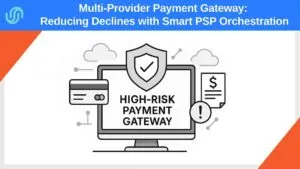
Illustration of a high-risk payment gateway with smart PSP orchestration showing card, warning icon, and security shield on a monitor.

Declined payments are more than a technical glitch — they’re lost conversions, frustrated users, and lower LTV. In high-risk industries like iGaming, dating, crypto, and Forex, decline rates can easily exceed 30%, especially when relying on a single PSP. That’s why leading merchants are adopting multi-provider payment gateway architectures powered by smart PSP orchestration platforms. These systems intelligently route transactions, apply fallback logic, and monitor performance — all with one goal: decline rate optimization.

In this article, we show how to reduce failed payments using orchestration strategies and real-world routing logic, without rebuilding your stack.

Multi-Provider Payment Gateway: Reducing Declines with Smart PSP Orchestration Read More »
Smart Payment Routing vs Cascading Payments: What’s Better for Your Payment Strategy?

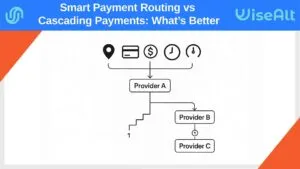
Black and white flowchart illustrating smart payment routing and cascading payments for high-risk transaction optimization.

In high-risk industries like iGaming, Forex, crypto, and adult services, payment approval rates can make or break your business. That’s why choosing the right routing logic for your PSP setup is critical.

Two of the most powerful tools in modern payment infrastructure are smart payment routing and cascading payments.

Smart Payment Routing vs Cascading Payments: What’s Better for Your Payment Strategy? Read More »