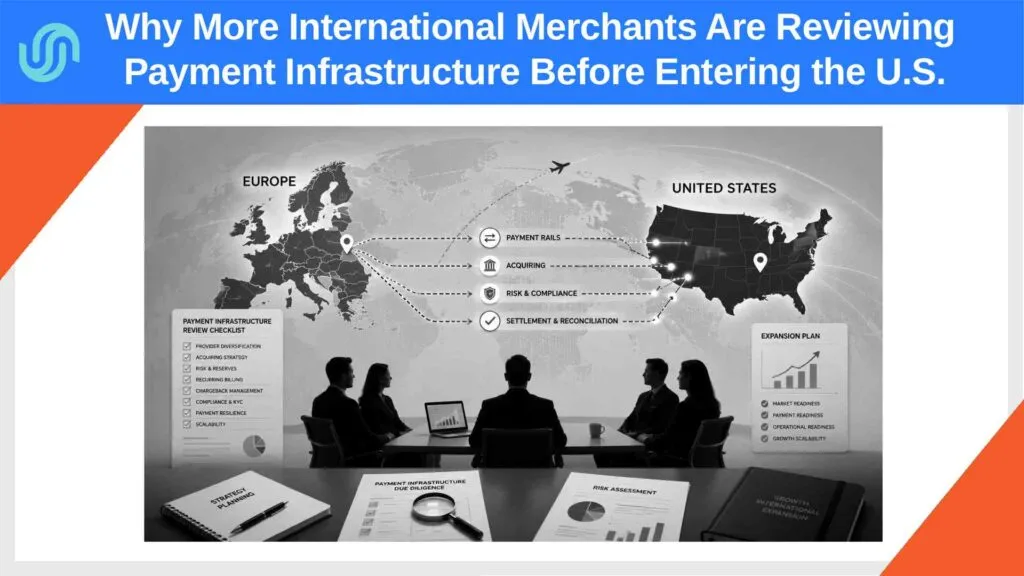
Why More International Merchants Are Reviewing Payment Infrastructure Before Entering the U.S.
International expansion has traditionally focused on market demand, legal structure, taxation and logistics. Increasingly, however, businesses are discovering that payment infrastructure deserves attention long before the first customer transaction takes place.
For many international merchants, especially subscription businesses, digital services, wellness brands and other higher-risk business models, payment infrastructure can directly influence launch speed, authorization rates, customer experience and long-term revenue stability. As a result, payment readiness is becoming an important part of commercial planning rather than simply an operational task.
The United States illustrates this particularly well. While European merchants often build payment operations around SEPA transfers, IBAN-based banking and familiar acquiring relationships, the U.S. ecosystem follows different principles. ACH payments, eChecks, domestic acquiring expectations, underwriting practices and provider-specific risk policies can all affect whether a payment strategy remains effective after expansion.
Industry organizations such as the Nacha, which oversees the ACH Network, and the Federal Reserve, which provides information about U.S. payment systems, illustrate how the American payments landscape differs from many European markets.
For businesses that already process payments successfully in Europe, these differences are not necessarily obstacles—but they do require planning.
Looking Beyond the Payment Processor
One of the most common misconceptions during U.S. expansion is treating payment infrastructure as synonymous with selecting a payment processor.
In practice, successful payment operations depend on a broader set of factors, including:
- provider diversification;
- acquiring strategy;
- reserve exposure;
- recurring billing architecture;
- chargeback management;
- payment routing resilience;
- settlement structure;
- onboarding readiness.
For businesses operating in subscription-based or regulated sectors, these considerations can become even more important than headline processing fees.
Why Investors Are Paying More Attention
The same questions increasingly appear during investment and acquisition discussions.
Whether an investor is based in North America or Europe and is evaluating a European digital business with U.S. growth ambitions, payment infrastructure may affect both operational scalability and commercial risk.
Traditional due diligence typically reviews financial performance, legal matters and technology. Payment infrastructure reviews complement these areas by examining whether existing payment operations can support future expansion without creating unnecessary operational bottlenecks.
U.S. Expansion Requires a Different Mindset
International merchants frequently discover that simply replicating their European payment setup does not always produce the same results in the United States.
Businesses entering the U.S. often evaluate domestic acquiring options, ACH or eCheck capabilities, payment-provider redundancy and recurring billing optimization before increasing marketing investment.
Some companies initially validate demand through a cards-only strategy before expanding into a broader payment architecture. WiseAlt recently explored this approach in its guide to PayPal card processing USA for EU projects, explaining where a simplified payment model may be appropriate and when additional infrastructure should be considered.
Canada may also form part of a broader North American strategy, but payment planning should generally be approached separately. Canadian payment rails, domestic payment methods and banking practices differ from those used in the United States, making Canada a distinct rollout rather than simply an extension of a U.S. launch.
A More Structured Review Before Growth
As expansion projects become more complex, many businesses now perform structured payment reviews before changing providers, entering new markets or preparing for investment.
WiseAlt’s Payment Infrastructure Due Diligence service helps investors and international merchants evaluate payment resilience, provider dependency, reserve exposure, onboarding readiness and long-term scalability before major commercial decisions are made.
For businesses preparing specifically for the American market, WiseAlt’s USA Payment Solutions resource provides additional guidance on payment acceptance, market-entry planning and U.S. payment infrastructure considerations.
Rather than viewing payments as a final implementation step, more international businesses are beginning to treat payment infrastructure as part of their overall market-entry strategy—an approach that can reduce operational friction and support more sustainable growth.